The Kimono in the Frame: Photographing Japan’s National Dress as Fine Art
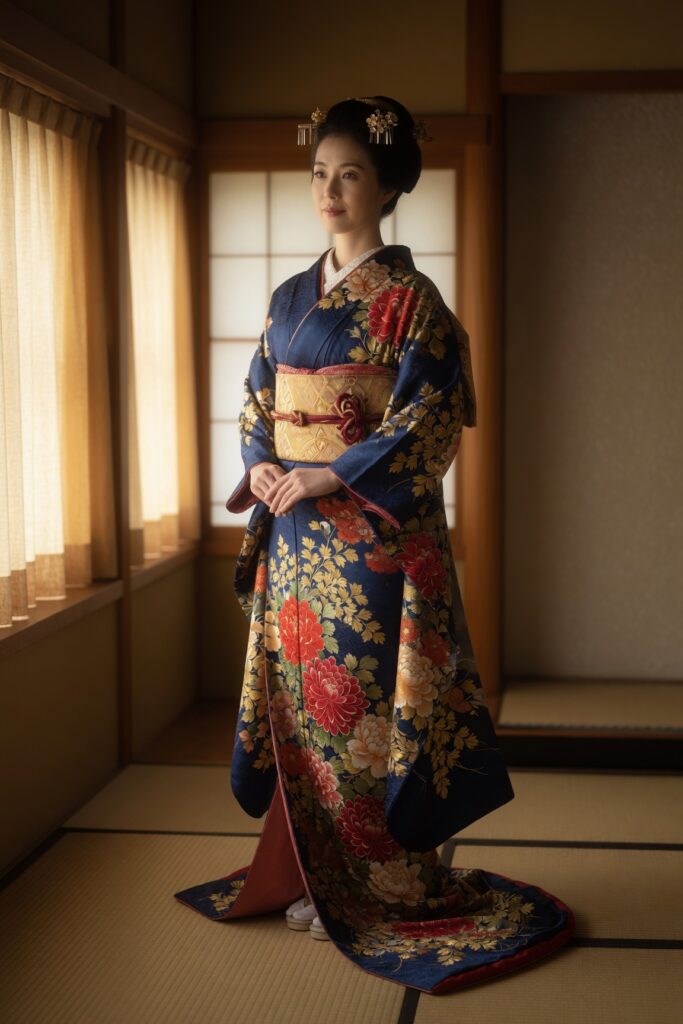
There are garments, and then there are garments that carry a civilisation in their folds. The kimono – literally “thing to wear” – is among the latter: a T-shaped robe whose deceptive simplicity conceals centuries of textile innovation, seasonal ritual, and social meaning. For the fine-art photographer, it presents a subject of rare depth. A single kimono can contain hand-painted landscapes, resist-dyed geometry, and brocade woven from threads of gold – all draped on a living body that moves, breathes, and catches the light in ways no flat textile ever could. To photograph a kimono well is to engage with materiality, culture, and the human form simultaneously.
This article explores why the kimono deserves sustained attention from serious image-makers, and how to approach it – from understanding its textile DNA to lighting its surfaces, styling it with integrity, and placing it within the broader tradition of fine-art and editorial photography.
A garment with a thousand-year memory
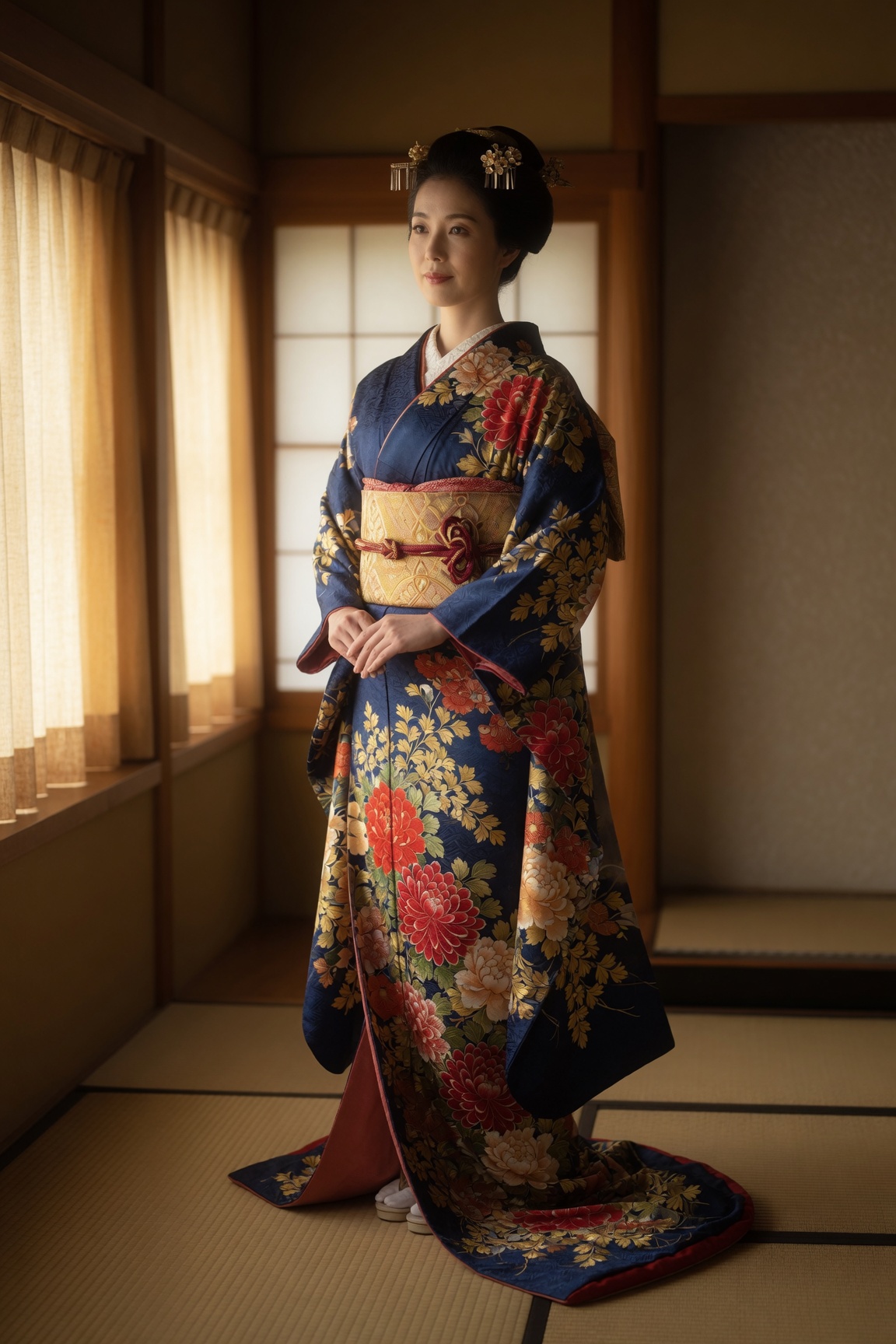
The kimono’s ancestry stretches to the Heian period (794-1185), when the Japanese court developed a distinctive layered style of dress that broke decisively from Chinese Tang-dynasty influence. The junihitoe – the “twelve-layer robe” worn by Heian noblewomen – established a principle that would define Japanese textile art for a millennium: colour, pattern, and layering as a language.
Over the following centuries, the garment evolved through the warrior pragmatism of the Kamakura era (1185-1333), the theatrical flamboyance of the Momoyama period (1573-1600), and the codified elegance of the Edo period (1603-1868), when sumptuary laws dictated which colours and motifs could be worn by each social class. Purple was famously reserved for the imperial family. Merchants, barred from displaying overt wealth, channelled their fortunes into exquisite linings – visible only in glimpses – and into the refinement of dyeing techniques that remain living arts today.
The textile crafts behind the cloth
What makes the kimono so photogenic is, in large part, what makes it so expensive: the textile techniques behind it are among the most sophisticated on earth.
Yuzen dyeing – named after the Kyoto fan painter Miyazaki Yuzensai, who codified its methods in the late seventeenth century – uses resist paste piped along drawn outlines to create scenes of extraordinary pictorial detail. A single formal furisode (long-sleeved kimono) can take a year of hand-painting, with motifs flowing uninterrupted across seams.
Shibori – resist dyeing by binding, stitching, folding, or clamping cloth before immersion – arrived in Japan from India around the seventh century and reached its zenith in Kyoto’s Arimatsu district during the Edo period. Its characteristic organic textures, from the pinpoint dots of kanoko shibori to the bold geometries of itajime, offer photographers surfaces that are endlessly responsive to directional light.
Nishijin-ori, the brocade weaving tradition of Kyoto’s Nishijin district, produces obi sashes and formal kimono fabrics of startling density and lustre. Established after the Onin War (1467-1477), Nishijin weaving employs pre-dyed threads in techniques including damask, gauze, and velvet – creating patterns that sit within the cloth rather than on its surface.
These are not museum curiosities. All three traditions are practised today by designated artisans and workshops, and their products continue to enter the market as wearable garments, though at price points that reflect the hundreds or thousands of hours invested in each piece.
Why the kimono is a demanding subject
Fabric behaviour
Unlike tailored Western garments, the kimono has no darts, no curved seams, and no structured shoulders. Its form depends entirely on the body beneath it and the way it is wrapped, folded, and tied. For a photographer, this means the garment is always in conversation with gravity – its drape shifting with every movement of the wearer, its sleeves catching and releasing air. A slight turn of the torso can transform the geometry of the obi knot; a raised arm can reveal an entirely different colour palette in the lining.
Pattern and scale
Kimono patterns operate at multiple scales simultaneously. A formal houmongi (“visiting wear”) may carry a painted landscape that spans the entire garment, aligned precisely across seams – meaning the pattern logic is architectural, not modular. At the same time, the weave of the base fabric contributes its own micro-texture. Managing both scales in a single frame – and deciding which to privilege – is a compositional challenge that rewards careful lens choice and controlled depth of field.
Seasonality and symbolic density
Traditional kimono dressing follows the principle of koromogae (seasonal wardrobe change) and the rule of “one season ahead”: cherry blossom motifs are worn a month before the blossoms appear, not during or after. Chrysanthemums signal autumn; pine and bamboo suggest resilience in winter. For the photographer working with a stylist or dresser, understanding this calendar is not pedantry – it is the difference between an image that reads as informed and one that reads as costume.
Light and composition for textiles
Reading the surface
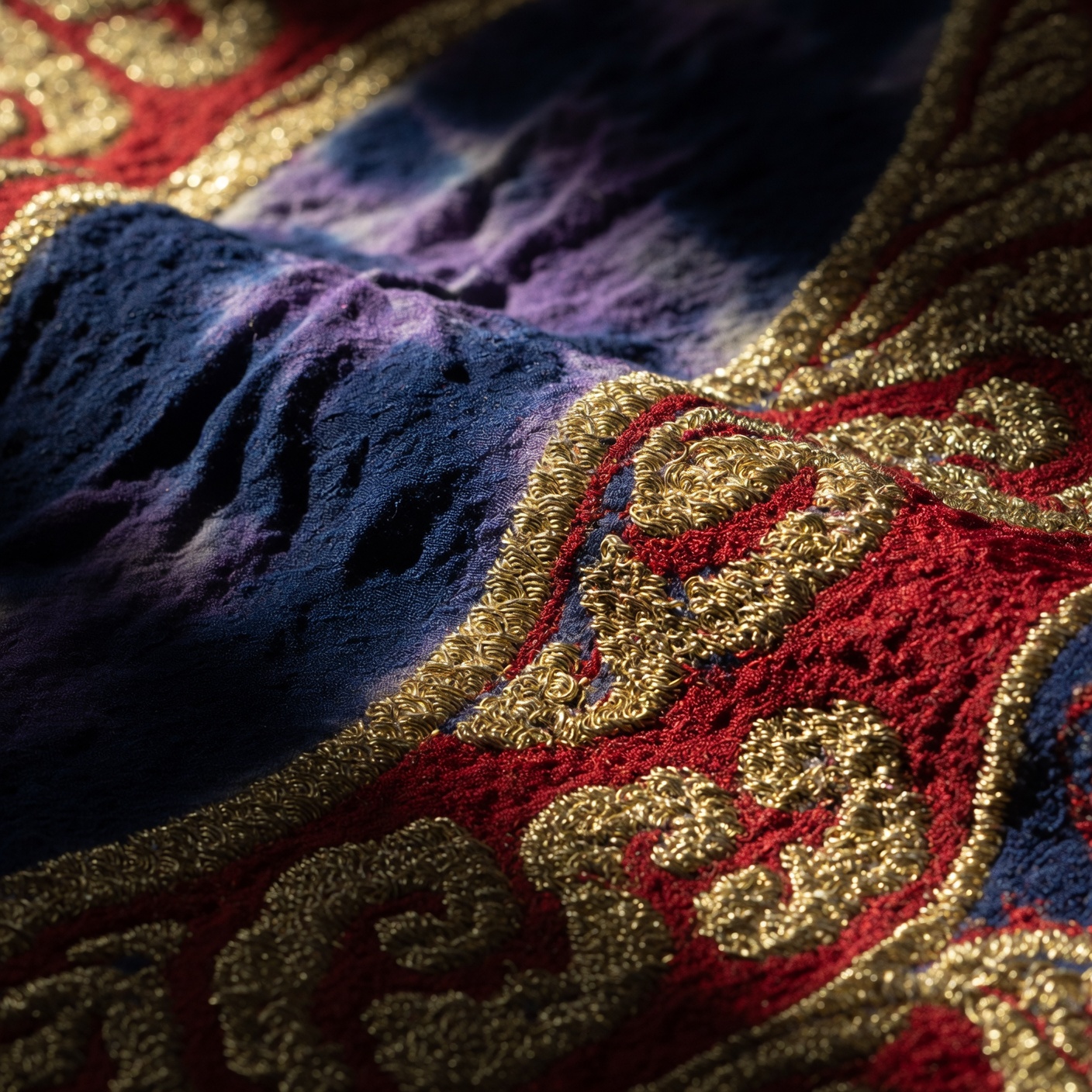
The first decision in lighting a kimono is whether to reveal structure or colour. Hard, raking light from a low angle will expose every thread of a Nishijin brocade, turning the surface into a landscape of ridges and valleys. Soft, diffused light will flatten that texture but allow dyed colours to read as the artisan intended – saturated and even. Most successful kimono photographs negotiate between these extremes, using a primary soft source for overall colour fidelity and a secondary harder source – or a reflector – to selectively lift texture.
Backlighting and translucency
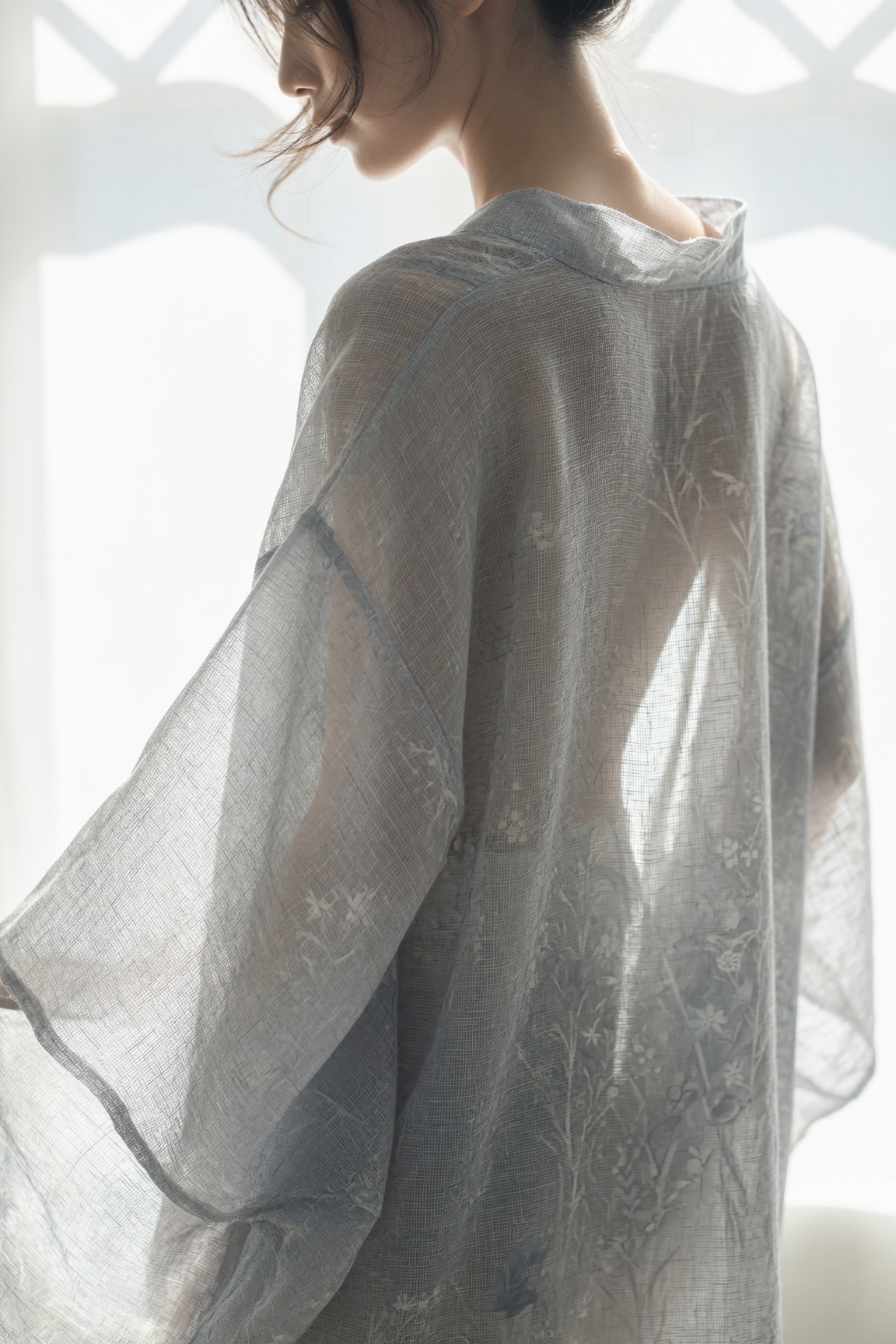
Lighter silk fabrics, particularly summer ro (gauze weave) and sha (leno weave), become partially translucent when backlit. This can be used to extraordinary effect: the weave structure becomes visible as a geometric overlay on the silhouette of the body beneath. For the photographer willing to experiment, backlighting transforms the kimono from an opaque surface into a luminous screen. Handled with restraint, the result is sensual rather than explicit – the form of the body registering as a presence beneath the cloth, suggested and withheld rather than shown. Much of the kimono’s erotic charge in Japanese aesthetics has always lived in exactly this register: concealment that hints, rather than reveals.
Compositional frameworks
The kimono’s geometry lends itself naturally to certain compositional strategies. The strong vertical lines of the front overlap (okumi) and the horizontal band of the obi create a built-in grid that can anchor a frame. The trailing diagonal of a sleeve in motion introduces dynamism. Many photographers find that the kimono responds particularly well to negative space – a figure in kimono placed against an uncluttered background allows the textile to function as the image’s primary visual event.
For those looking for a practical guide to capturing the kimono on camera, the interplay of these elements – light, texture, and composition – forms the technical foundation on which creative decisions are built.
Styling and respectful representation
Working with a kimono dresser
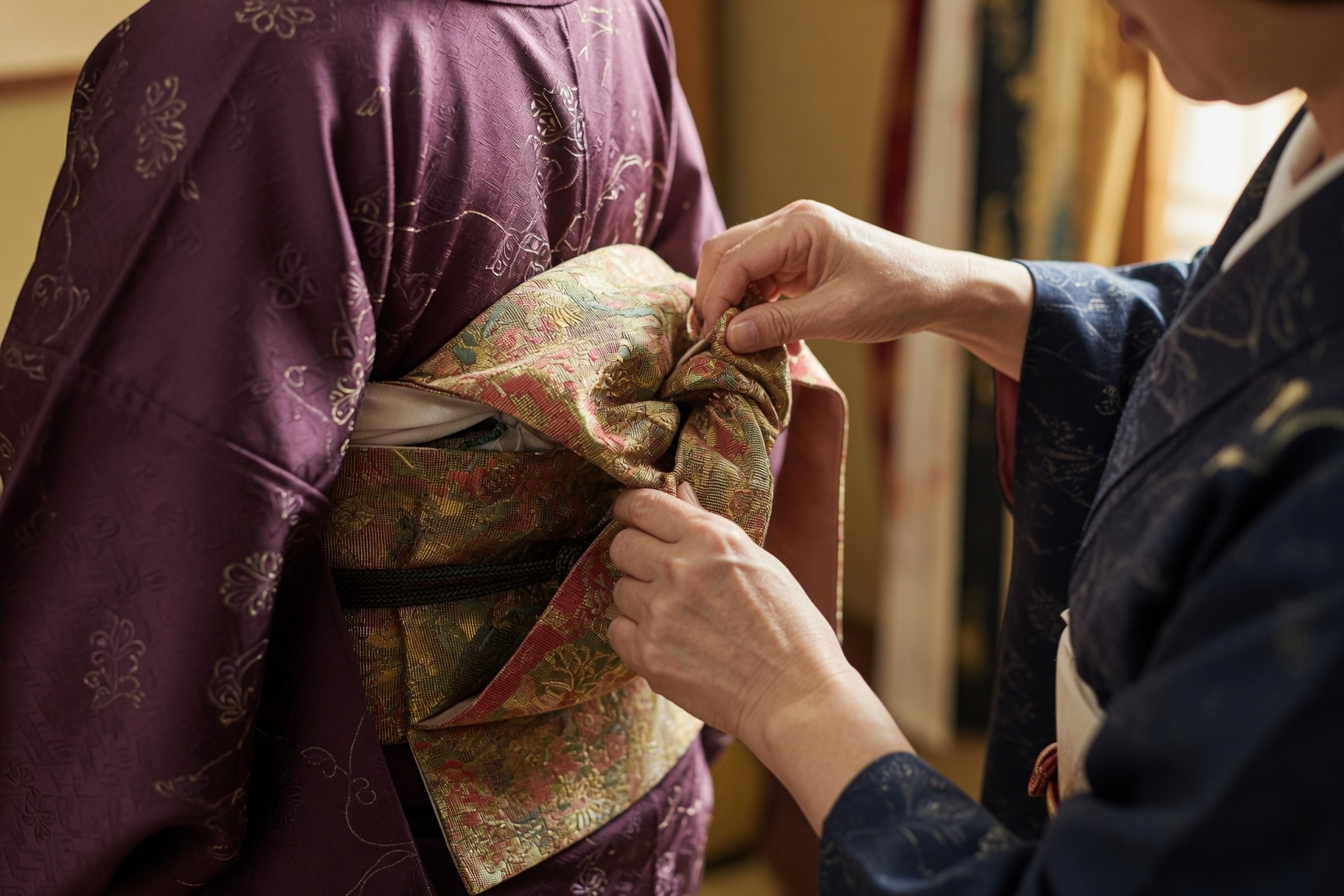
A kimono cannot simply be thrown on. Formal dressing involves an underlayer (nagajuban), a precise sequence of folds and ties, and the shaping of the obi into one of dozens of established knot styles – each with its own social register. The taiko musubi (drum knot) is standard for married women; the bunko musubi (library knot) is lighter and younger. Getting this wrong is immediately visible to anyone with even passing familiarity with the garment.
For a serious shoot, engaging a professional kitsuke-shi (kimono dresser) is not a luxury but a necessity. They will ensure the collar sits at the correct angle (drawing it back to expose a triangle of nape – the unaji, long regarded in Japanese aesthetics as one of the most quietly sensual points of the body, and for centuries a deliberate focus of a kimono’s allure), that the ohashori (tuck fold) is even, and that the overall silhouette is correct for the formality of the garment. Production platforms such as the group’s talent and production network can be instrumental in sourcing specialists with the right credentials for this kind of culturally specific styling work.
Authenticity and cultural sensitivity
The kimono occupies a particular position in conversations about cultural representation. The Victoria and Albert Museum’s landmark exhibition “Kimono: Kyoto to Catwalk” (2020) – which displayed over 350 garments tracing the kimono’s influence from Edo-period Japan to contemporary Western fashion – made the case that the kimono has always been a global garment, adopted and adapted across cultures for centuries (V&A Kimono Exhibition).
At the same time, many Japanese commentators and artisans have expressed clear views on what respect looks like in practice: understanding the garment’s context, wearing it correctly, and not reducing it to exotic decoration. Surveys and interviews consistently suggest that most Japanese people welcome thoughtful foreign engagement with kimono – particularly given concerns about the declining domestic kimono industry – but that shallow or stereotyped depictions cause genuine discomfort.
For the fine-art photographer, the practical takeaway is straightforward: invest in knowledge. Understand what you are photographing. Work with people who know the garment from the inside. Let the image reflect that understanding, and the cultural question largely answers itself.
The kimono in editorial and fine-art photography
Historical currents
The kimono entered Western photographic consciousness in the late nineteenth century, initially through the Japonisme craze that swept Europe and America after Japan’s forced opening in the 1850s. Early studio portraits of women in kimono – both Japanese and Western – tended toward the orientalist, treating the garment as theatrical prop rather than living culture. These images, while historically significant, are more instructive as cautionary examples than as models.
Within Japan, the kimono has been a constant presence in photographic practice. Nobuyoshi Araki, one of the most prolific Japanese photographers with over five hundred published photobooks since 1970, has repeatedly used the kimono as a charged element in his work – exploring tensions between tradition and transgression, formality and intimacy. His images for publications including Dazed Magazine (2015), featuring actress Rila Fukushima, demonstrate the kimono’s capacity to anchor editorial narratives that operate on multiple registers.
Contemporary fine-art approaches
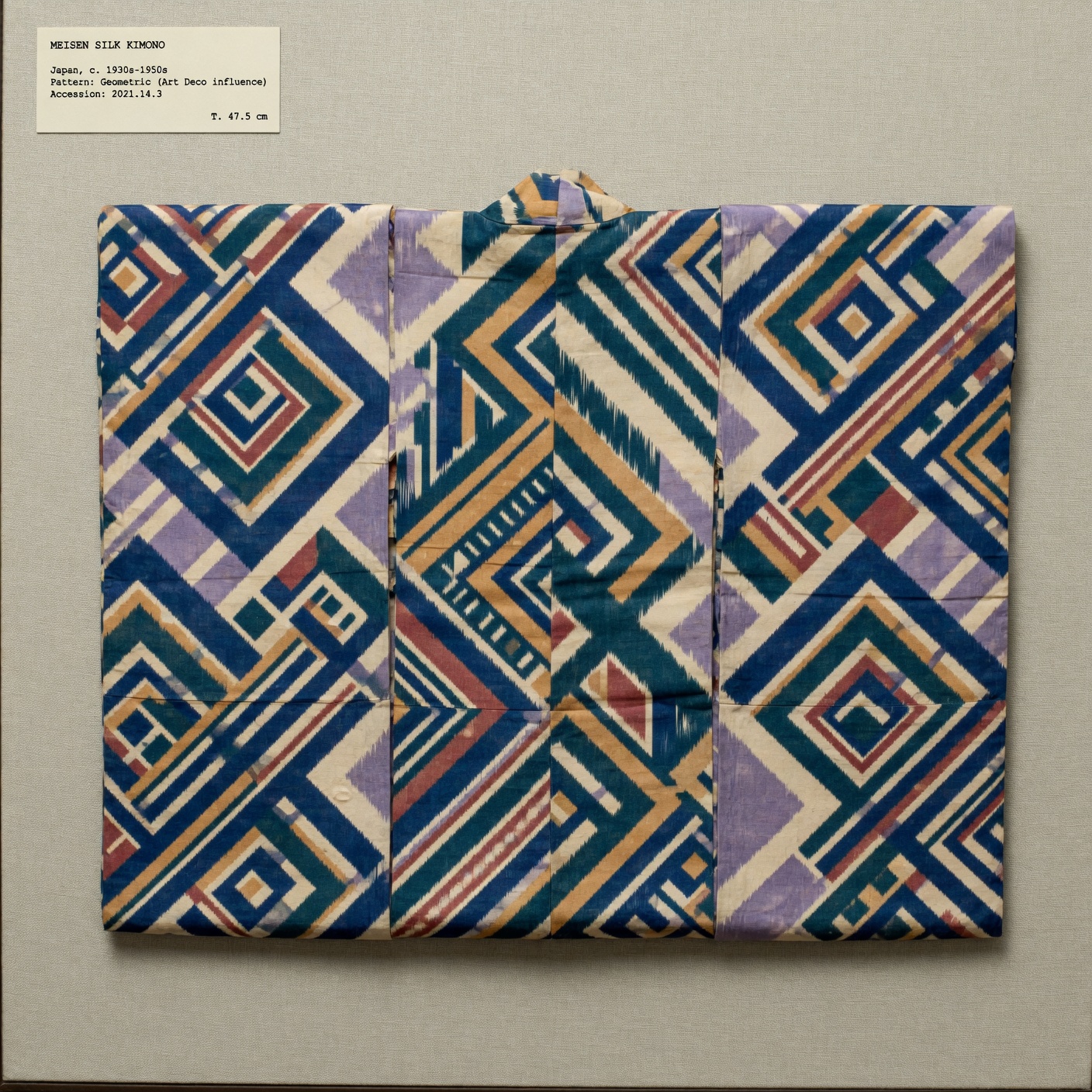
Ishiuchi Miyako – winner of the 2014 Hasselblad Foundation International Award, widely regarded as photography’s highest honour – has dedicated a significant body of work to the kimono as material artefact. Her series Silken Dreams (2012) photographed meisen silk kimono from the Taisho and Showa eras (1910s-1980s) as translucent, ghostly objects, lit from behind to reveal weave structure and wear. The garments appear without bodies, yet they are intensely physical – creased, stained, inhabited by the memory of the women who wore them. The series was exhibited at the Marugame Genichiro-Inokuma Museum of Contemporary Art and subsequently toured internationally (Ishiuchi Miyako at Smithsonian).
The Metropolitan Museum of Art’s “Kimono Style: The John C. Weber Collection” presented kimono as objects of formal beauty and social documentation, tracing transformations from the late eighteenth through the early twentieth century (Met Museum Kimono Style). For photographers, such exhibitions are invaluable references – not only for the garments themselves but for the curatorial strategies of display, lighting, and contextualisation.
The editorial space today
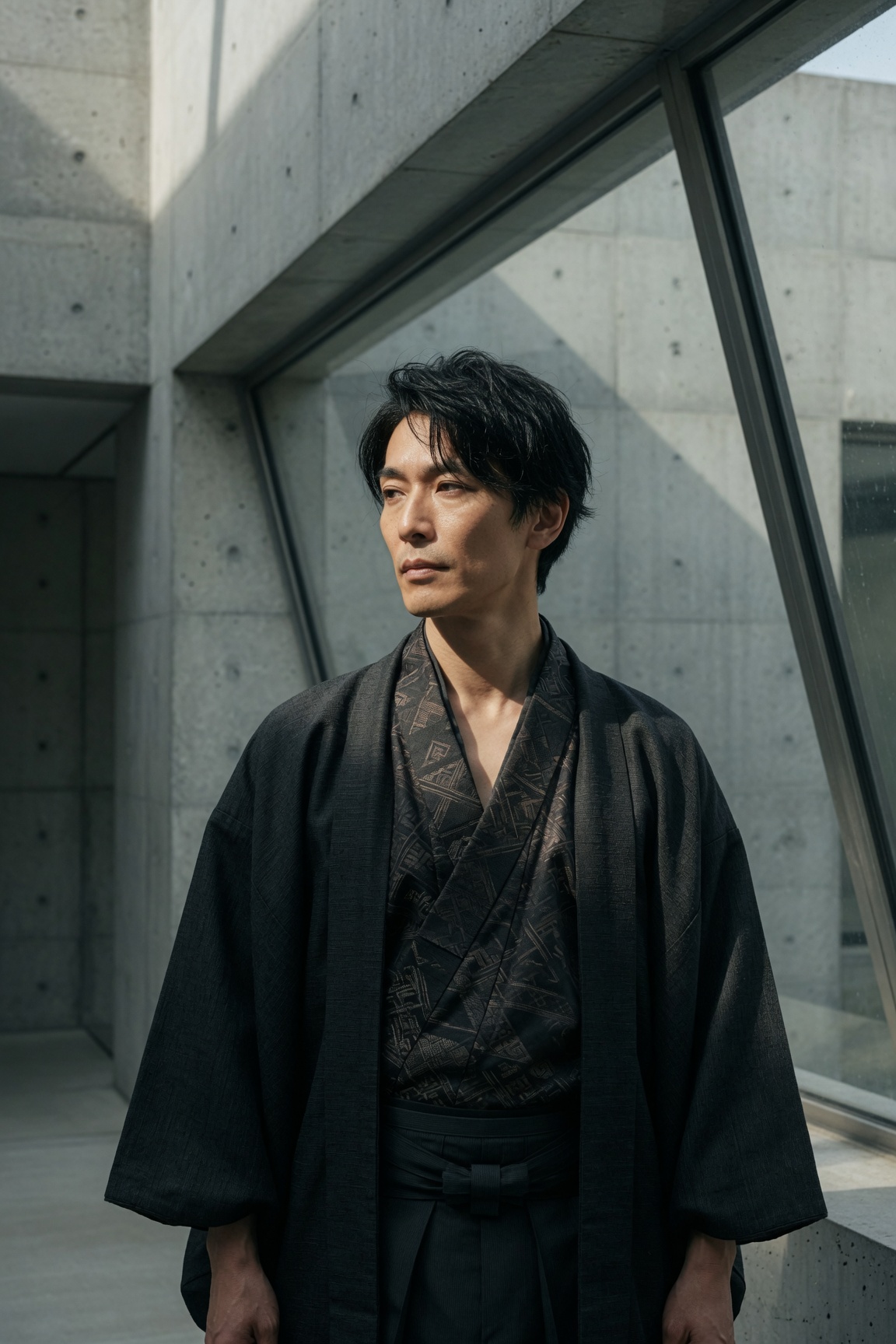
Contemporary editorial photographers working with kimono tend to fall into two broad camps. The first treats the kimono as high fashion, integrating it into shoots that borrow the visual grammar of luxury advertising – clean backdrops, controlled lighting, model-forward framing. The second, more documentarian approach photographs kimono in context: tea ceremonies, festivals, daily life in Kyoto’s textile districts, the workshops of ageing artisans. Both approaches produce compelling work, but for the photographer aspiring to fine-art credibility, the richest territory often lies in the space between – images that are formally accomplished and culturally grounded.
The market for kimono imagery
Photobooks and limited editions
The kimono has proven a durable subject for photobooks, a format in which Japanese photography has historically excelled. The combination of rich colour, intricate pattern, and cultural narrative makes kimono imagery well-suited to the large-format, high-production-value books favoured by serious collectors. Ishiuchi Miyako’s publications on textile subjects, for instance, have been issued by Aperture – one of the most respected names in photography publishing.
Print sales and collector appeal
Fine-art prints featuring kimono imagery occupy a distinct niche: they appeal simultaneously to collectors of photography, of Japanese art, and of textile art. This cross-category appeal is commercially significant. Platforms like Fine Art America list thousands of kimono-related prints, but the serious market is defined by gallery representation and limited editions.
The Khalili Collection – one of the world’s most important private collections of kimono, comprising over 450 garments – demonstrates the broader collector appetite for kimono as cultural artefact. When this interest is paired with fine-art photography of equivalent seriousness, the result is work that finds receptive audiences in both art-photography and Japanology circles.
What buyers respond to
Based on trends across gallery sales and online platforms, the strongest-performing kimono imagery tends to share certain qualities: technical mastery in rendering textile surfaces, a sense of narrative or emotional weight beyond mere documentation, and evidence that the photographer understands what they are showing. Decorative images sell to the interiors market; substantive images build careers.
Conclusion
The kimono is not a prop. It is a textile tradition of extraordinary sophistication, a social document, and a living art form – and it deserves to be photographed as all three. For the image-maker willing to invest the time in understanding its history, its materials, and its cultural protocols, the kimono offers a subject that rewards technically, aesthetically, and intellectually. Few garments carry as much meaning per square centimetre of fabric. The challenge – and the privilege – is to get that meaning into the frame.
Note on sources: Historical dates, textile terminology, and exhibition details in this article are drawn from institutional sources including the Victoria and Albert Museum, the Metropolitan Museum of Art, the Smithsonian’s National Museum of Asian Art, and Kyoto’s traditional craft documentation. Estimates of production timelines for handcrafted kimono vary by technique and artisan; figures cited reflect ranges commonly reported by Japanese textile scholars and industry bodies.