Trust by Design: Consent, Safeguarding and Professional Ethics in Photography
A working framework for informed consent, likeness protection and accountability on set and online.
Photography is built on a relationship between the person behind the camera and the person in front of it. That relationship only works when both sides understand what they are agreeing to, what protections are in place, and what happens to the images afterwards. In an era of instant global distribution and generative AI, those questions are more urgent than they have ever been.
This article examines the practical and legal mechanisms the photography industry uses – and increasingly must use – to keep that relationship honest. From model releases and data-protection obligations to chaperone requirements and platform-level accountability, the goal is the same: trust by design, not by accident.

Informed Consent and the Model Release
What a release actually is
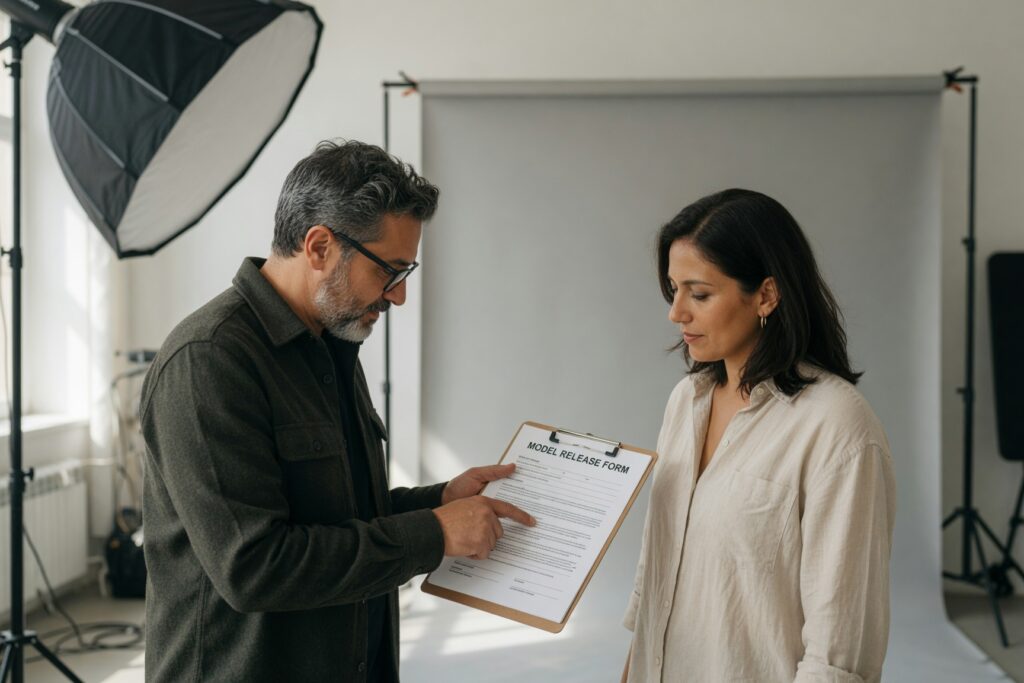
A model release is a written agreement in which a photographed person grants specific permission for the use of their likeness. It is not a formality. It is a contract that defines the scope of permitted use – which media, which territories, which duration – and the consideration (payment, prints, or other value) offered in return.
Industry-standard releases for commercial work typically specify “perpetual, worldwide, all media” rights. Stock libraries such as Getty Images and Adobe Stock will not accept submissions without a signed release for any identifiable person. Editorial work, by contrast, generally does not require a release, though ethical practice still demands transparency about how images will be published.
The shift to digital and auditable consent
Paper releases are giving way to digital equivalents with timestamped audit trails. Services such as SnapSign and the built-in release tools on major stock platforms create a verifiable chain of evidence: who signed, when, and to what they agreed. That audit trail matters years later if a use dispute arises or a stock submission is challenged.
Digital releases also make it easier to document the withdrawal of consent. Under the EU’s General Data Protection Regulation (GDPR), a photograph of an identifiable person constitutes personal data. Article 17 – the “right to erasure” – means a subject can request deletion of their images when consent is withdrawn, so long as no overriding legal basis (such as journalistic freedom of expression or the defence of a legal claim) applies. Photographers and agencies must know where every image is stored to honour such a request. GDPR Local’s guidance on images and personal data provides a thorough overview of these obligations.
AI and the new consent gap
Standard release language covering “all media now known or hereafter devised” was drafted for print, broadcast and web. It was not written to authorise the creation of a digital replica or a generative-AI derivative of a person’s appearance. New York’s Fashion Workers Act, which took effect on 19 June 2025, explicitly requires separate, scoped consent for any AI use of a model’s likeness. The broader industry is following: agencies and unions increasingly recommend that AI rights be negotiated as a distinct line item, not buried in boilerplate.

Protecting a Subject’s Likeness Online
The impersonation problem
Once a photograph is published online, it can be downloaded, re-contextualised and weaponised within minutes. Impersonation – using someone’s image to create fake social-media profiles, fraudulent advertisements or manipulated “deepfake” video – is one of the fastest-growing forms of image misuse.
Washington State’s House Bill 1205, effective since July 2025, criminalises the intentional use of a “forged digital likeness” when the purpose is to defraud, harass or intimidate. At the federal level, the proposed DEFIANCE Act would give victims a civil cause of action against non-consensual deepfake distribution, while the NO FAKES Act would criminalise unauthorised AI-generated copies of a person’s voice or likeness. Roughly 38 US states now recognise some form of “right of publicity” – the right to control the commercial use of one’s own name and image – though the scope varies state by state (National Law Review summary of the Fashion Workers Act).
Recognising and responding to misuse
For working models and public-facing creatives, the practical challenge is detection. Reverse image searches, watermark tracking and contract clauses requiring licensees to report sub-licensing can all help, but they rely on vigilance. Guides on recognising impersonation and protecting a likeness offer structured checklists for identifying when images have been re-used without authorisation and what steps to take – from platform takedown requests to formal legal action.
Production companies and agencies share responsibility here. A professional outfit that publishes model images should maintain a record of where those images are distributed and monitor for unauthorised use as part of its duty of care.
Transparency of On-Set Roles and Staff
Why everyone should know who is in the room
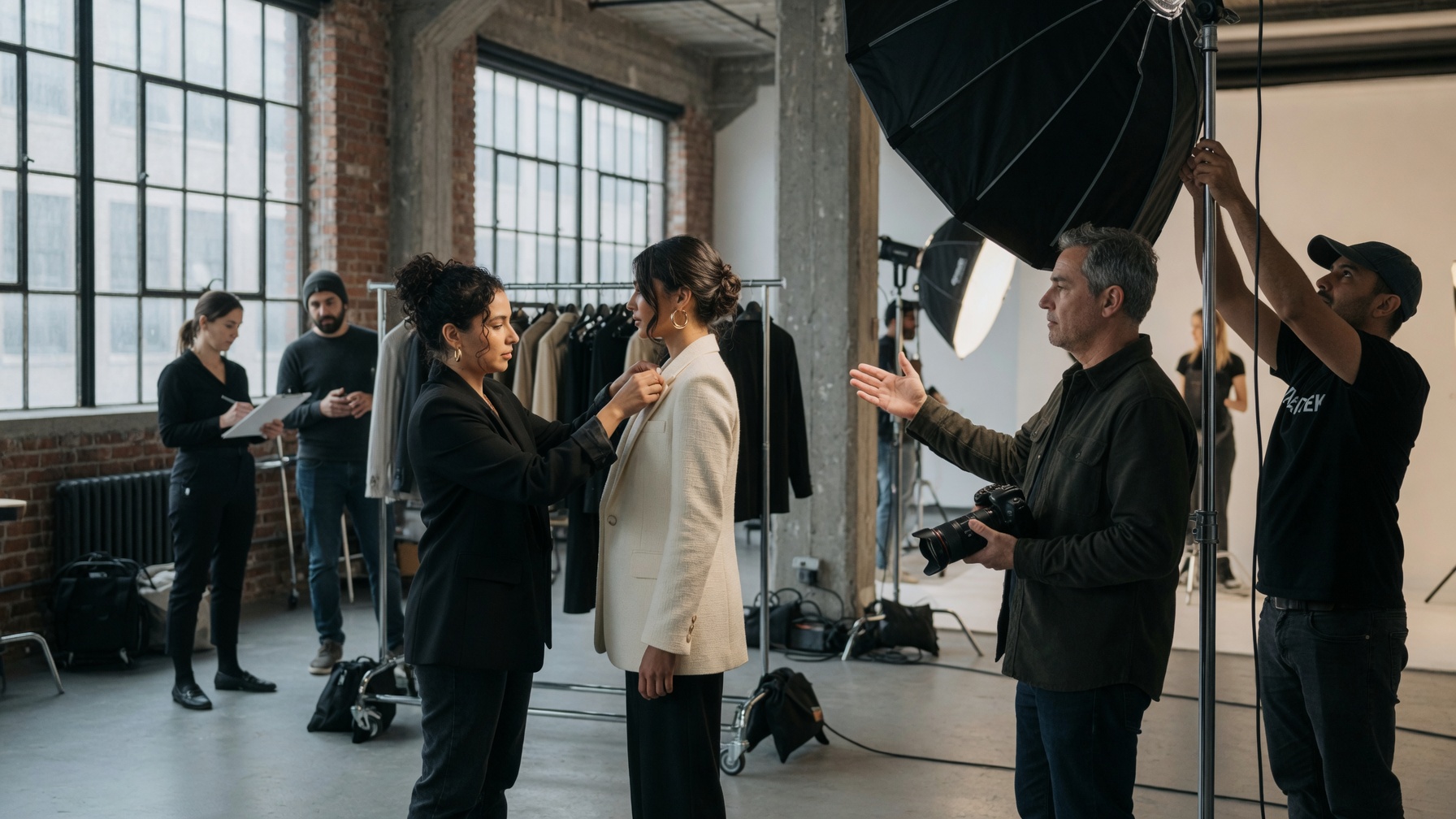
A professional photography set is a workplace. Like any workplace, it functions best when every person present has a defined role, and everyone else on set knows what that role is. Introductions at the start of a shoot are not just polite – they are a safeguarding measure. A model or subject who does not know whether the person adjusting a light is a qualified technician, a client observer or an uninvited visitor cannot make informed decisions about their own boundaries.
The British Fashion Model Agents Association (BFMA) Code of Practice requires that photographers not known to the agency sign a test release and personal statement of good conduct before working with any model. Members must meet new photographers at the agency or studio and conduct due diligence. Except where the photographer is well known, agencies should avoid sending models alone, with models attending in pairs and those under 18 being chaperoned (BFMA Code of Practice).
The value of candid feedback from crew
Set culture is shaped by the people who work on it every day – stylists, lighting technicians, hair and make-up artists, digital operators. Their perspective on what constitutes a professional, respectful working environment is invaluable, and productions that actively solicit that feedback tend to catch problems early. Candid, honest perspectives from on-set staff shed light on the day-to-day realities of set dynamics and the difference between a shoot that merely follows the rules and one that genuinely feels safe.
Transparency also extends to communication about the creative brief. A model who arrives expecting a portrait session but is asked to participate in something more physically demanding or emotionally challenging has a right to decline. Pre-shoot briefings that lay out the concept, wardrobe, level of physical contact (if any) and the names and roles of everyone present are a baseline standard, not a luxury.
Safeguarding Younger and Junior Contributors
The legal framework
Photography and fashion are industries where younger contributors – whether child actors in advertising, junior models in catalogue work, or teenage performers – need explicit, structured protection. In the UK, the Children (Performances) Regulations 1968 (as amended) require that any child taking part in a performance or a paid shoot be under the supervision of a licensed chaperone, a parent or a teacher. The minimum ratio is one chaperone for every twelve children. Chaperones must hold a licence issued by their local authority, which requires a DBS (Disclosure and Barring Service) check, safeguarding training, and two references.
The chaperone acts in loco parentis – with the authority and obligation to say no when requests would be detrimental to the child’s health, wellbeing or education. This is not a ceremonial role. It is a legal one, and productions that treat it as optional expose themselves to criminal liability.
Practical safeguarding measures
Beyond the legal minimum, responsible productions adopt a layered approach:
- Written, specific consent from a parent or legal guardian. Generic blanket releases are insufficient. The guardian must understand exactly what the shoot involves – wardrobe, setting, duration, who will be present – before signing.
- Clear boundaries communicated in advance. What the child will and will not be asked to do, agreed in writing before the shoot date.
- A named safeguarding lead on set, distinct from the director or photographer, whose sole responsibility is the welfare of the younger contributor.
- Restricted working hours in line with local licensing requirements (in the UK, these vary by age and are enforced by the local authority).
- No unsupervised contact. Younger contributors are never left alone with any single adult other than their parent or licensed chaperone.
A guardian’s guide to protecting younger models walks through these expectations from the parent’s perspective – what to ask an agency, what paperwork to expect, and what red flags to watch for.
Industry self-regulation
The BFMA’s Best Practice Guide, developed in consultation with the British Fashion Council, sets out additional requirements for its member agencies: under-18 models must be accompanied on all jobs and test shoots; agencies must verify the identity and credentials of any photographer before introducing them to a younger model; and agencies must maintain a record of every booking involving a minor.
New York’s Fashion Workers Act extends similar protections to the US market. Model management companies now have a fiduciary duty to the models they represent, including an obligation to conduct due diligence to ensure that any engagement does not pose an unreasonable risk. For work involving nudity or sexually explicit material, the Act requires a separate, knowingly signed agreement – one that the model may rescind. Violations carry civil penalties of $3,000 for a first offence and $5,000 for subsequent ones, plus a private right of action for the model.
How Contracts and Platforms Build Accountability
The contract as a safeguard
A well-drafted contract does more than allocate rights. It creates accountability. It names the parties, specifies what is permitted and what is not, sets out the consequences of a breach, and provides a mechanism for dispute resolution. In photography, the contract layer includes:
- Model releases (as discussed above), specifying usage scope and AI rights.
- Booking confirmations that detail the date, location, duration, creative brief, wardrobe expectations, and the names and roles of key personnel.
- Usage licences between the photographer or production company and the end client, specifying where images may appear and for how long.
- Non-disclosure agreements where the subject matter is commercially sensitive (e.g., pre-launch product photography).
- Safeguarding agreements for shoots involving younger contributors, signed by the guardian and the production company.
Each of these documents should be legible, specific and available in the signer’s first language. A release written in dense legal jargon that the model cannot understand is not informed consent – it is a liability.
Platform-level infrastructure
Increasingly, the contract layer is moving into digital platforms that manage the entire lifecycle of a production: casting, booking, consent, image delivery and payment. A contract- and consent-based production platform can enforce standards that individual paper processes cannot. When a booking cannot proceed without a signed release, when payment is held in escrow until deliverables are confirmed, and when every communication is logged, the platform itself becomes a safeguarding mechanism.
This matters for several reasons. First, it reduces the power imbalance between an individual model and a large production company – the platform enforces the same rules for everyone. Second, it creates an auditable record that can be reviewed in the event of a dispute. Third, it makes compliance the path of least resistance rather than an optional extra.

The role of industry bodies
Trade associations and unions play a complementary role. The BFMA in the UK, the Model Alliance in the US, and national photographers’ associations (such as the Association of Photographers) set standards, investigate complaints and – in some cases – withdraw membership from agencies or individuals who breach their codes. The Fashion Workers Act goes further by requiring model management companies to register with the New York Department of Labor and subjecting them to state oversight.
These layers of accountability – contractual, platform-based and institutional – are not redundant. They reinforce each other. A contract is only as good as the willingness to enforce it; a platform is only as trustworthy as the standards it encodes; an industry body is only as effective as its members’ commitment to its code.
Building a Culture of Consent
The mechanisms described in this article – releases, data-protection obligations, chaperone requirements, transparent set protocols, digital platforms, industry codes – are tools. They work when they are used consistently and in good faith. They fail when they are treated as box-ticking exercises.
The photography industry’s best practitioners understand that consent is not a single event but a continuing conversation. A model who consented to a specific use of their image five years ago may feel differently today – and should have a clear, accessible route to say so. A guardian who signed a release for a catalogue shoot did not consent to the images appearing in a context they were never told about. A crew member who sees something that does not look right should have a channel to raise it without fear of losing future bookings.
Trust by design means building these principles into every stage of a production – from the first casting call to the final image delivery – rather than bolting them on as an afterthought. It is not always convenient. It is not always cheap. But it is the foundation on which professional, ethical photography stands.
Note on Sources
This article draws on publicly available legislation (UK Children (Performances) Regulations 1968, New York Fashion Workers Act 2025, EU General Data Protection Regulation), industry codes of practice (BFMA Code of Practice, British Fashion Council Best Practice Guide), and published legal analysis from the National Law Review, Morgan Lewis, and GDPR Local. Where figures are cited, they are labelled as estimates. The article does not claim affiliation with any media outlet or organisation. All external sources were accessed in August 2026.