Real vs Fake: How to Recognise a Legitimate Modelling Opportunity

Reading time: approx. 10 minutes
Every year, thousands of aspiring models receive a message that feels like the beginning of something extraordinary – a DM from a “scout,” an email from a “casting director,” or a compliment from a stranger who says they can change your life. Some of those messages are genuine. Many are not. The modelling industry, like any field that trades on aspiration, attracts predatory operators who profit not by booking talent for real work, but by extracting money, personal data, or compromising material from people who have not yet learned how to tell the difference.
This guide is a practical, no-nonsense walkthrough of what legitimate scouting actually looks like, the warning signs that separate a real opportunity from a scam, and the concrete steps you can take to protect yourself before you respond to a single message.
How Legitimate Scouting and Casting Actually Work
Understanding the real process makes it far easier to spot deviations from it.
Agency-side scouting
Established agencies employ bookers and scouts whose job is to find new faces. They may approach people in public places – city centres, universities, cultural events – but the interaction is brief and low-pressure. A legitimate scout will hand you a business card with verifiable contact details (a company email address, not a Gmail or Hotmail account), invite you to visit the agency’s office at your convenience, and never ask for money or photos on the spot.
Online scouting does happen, but it follows the same pattern: a short, professional message from a verifiable company account, directing you to an official website where you can submit digitals (simple, unedited snapshots – front, side, full-length) at no cost.
Casting calls
Professional casting calls are issued through established platforms, agency networks, or industry job boards. They specify the client or production, the usage rights, the rate or rate range, and the logistics. They do not promise fame, guaranteed income, or overnight success.
The commission model
This is the single most important structural fact to understand: legitimate modelling agencies earn money by taking a commission on work they book for you – typically 20-25% of your fee for each job. They do not charge you to join, to be “registered,” to build a portfolio, or to attend training. If an entity’s revenue comes from models rather than from clients paying for models, it is not operating as a genuine agency.
The Red Flags: What Scams Look Like in Practice
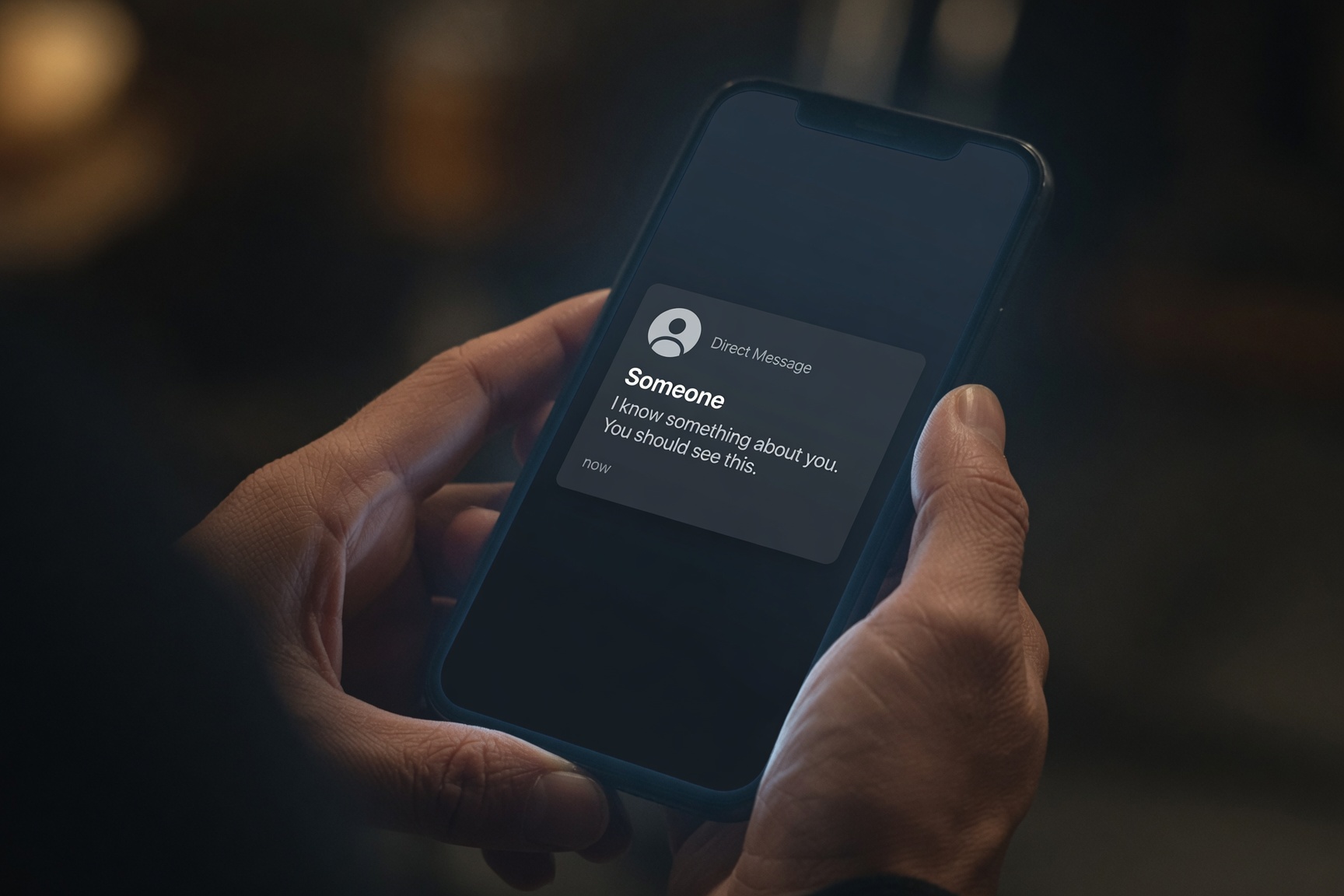
Scam operations have evolved significantly. Where the classic “mall scout” approach once dominated – a well-dressed stranger approaching you in a shopping centre and steering you toward a high-pressure “audition” – the primary vector in 2025-2026 is the unsolicited social media message. According to industry observers, DMs have largely replaced in-person cold approaches as the first point of contact for fraudulent operators (Photography Shark Studios, 2026).
Here are the patterns to watch for.
1. Unsolicited DMs from unverifiable accounts
A message lands in your Instagram or TikTok inbox: “You have an amazing look – we’d love to work with you!” The account may have a professional-sounding name, a polished bio, and even a grid of model photos. But look closer. Does the account tag working models who confirm the relationship in their own posts? Does it link to a registered business with a physical office? Are the “team members” on the website real, verifiable people – or stock photos and AI-generated headshots?
If you receive a cold DM from someone claiming to be a scout, a detailed guide to evaluating scout DMs and spotting red flags can help you work through the verification steps before responding.
2. Upfront fees of any kind
This is the single clearest signal. Scam operations commonly charge for:
- Registration or “booking” fees (often framed as small administrative costs of 20-100 pounds or dollars to lower resistance)
- Mandatory portfolio shoots with a specific photographer, typically at marked-up rates of 500-2,000 pounds or more, sometimes with kickbacks to the “agency”
- Training courses or “modelling schools” charging 1,500-5,000 pounds in tuition with minimal real industry connections
- Composite cards, website listings, or “exposure packages”
The rule is absolute: a real agency never charges you to be represented. The US Federal Trade Commission states plainly that any agency asking you for money to represent you is a scam (FTC Consumer Advice). In the UK, the same principle is upheld by consumer protection guidance from Trading Standards and Action Fraud.
3. Requests for explicit or compromising material
Some legitimate work – art-nude, lingerie or boudoir – does involve nude or implied-nude images, and an established agency may ask an adult model for test or portfolio shots tied to a specific, named project. The distinction is the context, not the request itself. A legitimate request comes only after real, verifiable contact (a referral, an established agency, a named client or project), states exactly what the images are for and how they will be used, is backed by a written agreement, and follows age and identity verification. It is never the price of entry demanded in a first, unsolicited message from an unverified stranger.
The clearest red flag is a request that arrives out of context: an unsolicited message, a demand made before any contract, named project or verification exists, or explicit images treated as the price of even being “considered”. In that situation the simplest safeguard is to slow down and ask for the project brief, the contract and the company’s verifiable details in writing before sending anything – a genuine operation will happily provide them, because a real project always has a real paper trail behind it. To see exactly how these approaches read in an inbox, our companion piece walks through eight example scout DMs and the red flag in each – from love-bombing to gift-card scams to the “everyone sends them” gatekeeper.
4. Vague or absent contracts
A professional engagement involves a written contract that specifies:
- The parties involved (your legal name and the agency or client entity)
- The scope of work, usage rights, and duration
- Payment terms, rates, and commission structure
- Termination clauses (typically 30-90 days’ notice)
- Intellectual property provisions – who owns the images and how they may be used
If there is no written contract, or if the contract is vague about image usage, geographic scope, or exclusivity, walk away. Legitimate contract-based platforms – such as the Vibelist talent and production platform – make their terms transparent and give talent time to review before signing.
5. Pressure tactics and artificial urgency
“This opportunity won’t wait.” “We need your answer today.” “The slot will be gone by tomorrow.” These phrases are designed to bypass your judgment. A real agency understands that signing a model is the beginning of a professional relationship – not a high-pressure sales close. You should always have time to take the contract home, read it carefully, and consult someone you trust.
6. Guaranteed success or income
No one can guarantee you bookings, earnings, or a career trajectory. The modelling industry is competitive and unpredictable. Any promise of specific income, “guaranteed exposure,” or “fast-track” representation is a sales tactic, not a reflection of how the industry works.
7. Requests for sensitive personal information early on
A legitimate initial meeting or casting does not require your bank details, copies of your passport or ID, or your home address. These details become relevant only when a contract is being finalised and payment is being arranged through proper channels. Early requests for this information may indicate identity theft or advance-fee fraud.
The Questions You Should Ask
Before engaging with any modelling opportunity, work through this checklist. A legitimate operation will have clear, verifiable answers to every question.

1. “What is your company’s registered name and address?” – Search this on Companies House (UK), your national business registry, or equivalent. If the company is not registered, it is not a professional agency.
2. “Can you name recent clients you have worked with?” – A real agency will reference verifiable commercial clients, publications, or productions. Cross-check these claims.
3. “What is your commission structure?” – The answer should be a percentage of your earnings on booked jobs (typically 20-25%). Any other payment model is a red flag.
4. “Will there be a written contract, and can I take it away to review?” – The answer must be yes to both. If you are pressured to sign on the spot, leave.
5. “Do you require me to pay for anything?” – The answer must be no. Portfolio development, comp cards, and training are either optional or arranged at market rates with photographers of your choice – never mandatory purchases through the agency.
6. “Can I speak to models currently on your books?” – A confident, legitimate agency will be happy for you to verify their reputation through their own talent roster.
7. “Where will the initial meeting take place?” – It should be at a professional office with other staff present. Never agree to meet at a private residence, hotel room, or any unsupervised location.
What a Professional, Contract-Based Operation Looks Like
Knowing what legitimacy looks like is just as important as knowing the red flags. Here are the hallmarks:
Transparent business registration. The entity is a registered company with a verifiable address, named directors or officers, and a public record.
A commission-only revenue model. The agency earns when you earn. There are no upfront charges, membership fees, or mandatory purchases.
Written contracts with clear terms. Every engagement is governed by a contract that specifies rates, usage rights, duration, exclusivity (if any), and termination provisions. You receive a copy to review before signing.
Professional communication. Correspondence comes from company email addresses, not personal accounts. Meetings take place in professional settings.
Respect for boundaries. A legitimate agency respects your right to decline work, set personal boundaries about the type of work you will accept, and take time to make decisions.
Verifiable track record. The agency can point to real campaigns, publications, or productions featuring models on their roster. Working models confirm the relationship publicly.
Compliance with employment and data-protection law. Contracts comply with local labour law. Personal data is handled in accordance with data-protection regulations (GDPR in Europe, equivalent frameworks elsewhere).
Protecting Yourself: A Step-by-Step Approach
If you receive an approach that interests you, here is a practical sequence to follow before committing to anything:
1. Do not respond immediately. Take time to research.
2. Verify the entity. Search the company name on your national business registry. Check for a professional website with named staff, a physical address, and a client list.
3. Reverse-image-search the profile. If the “scout” has a profile photo, run it through a reverse image search. AI-generated faces often appear in multiple unrelated contexts.
4. Search for complaints. Google the company name alongside words like “scam,” “review,” or “complaint.” Check consumer forums and social media.
5. Ask the checklist questions listed above. Note the responses carefully.
6. Never pay money. If you are asked to pay at any stage, disengage.
7. Never send intimate images. No legitimate assessment process requires them.
8. Bring someone with you. If you attend a meeting or casting, bring a friend, family member, or – if you are under 18 – a parent or guardian. Any operation that objects to this is not legitimate.
9. Get everything in writing. Verbal promises mean nothing. If it is not in the contract, it does not exist.
10. Trust your instincts. If something feels wrong, it probably is. Walking away from a suspicious opportunity costs you nothing. Engaging with one can cost you a great deal.
If You Have Been Scammed
If you believe you have fallen victim to a modelling scam:
- Stop all communication with the fraudulent party immediately.
- Preserve evidence – save all messages, emails, receipts, contracts, and screenshots.
- Contact your bank if you have made any payments, to explore chargebacks or fraud protection.
- Report the scam. In the UK, report to Action Fraud (actionfraud.police.uk) and contact Citizens Advice. In the US, report to the Federal Trade Commission at ReportFraud.ftc.gov. In the EU, contact your national consumer protection authority.
- Warn others. Sharing your experience on review platforms or consumer forums helps protect the next person.
The Bottom Line
The modelling industry contains genuinely exciting opportunities for the right people. But it also attracts operators who exploit aspiration, inexperience, and the desire to be seen. The difference between the two is almost always visible if you know where to look: legitimate agencies earn from clients, not from models; they use written contracts with clear terms; they never pressure, never demand money, and never ask for compromising material.
Take your time. Verify everything. And remember that any opportunity worth having will still be there after you have done your homework.
Note on Sources
This article draws on consumer protection guidance from the US Federal Trade Commission (consumer.ftc.gov), UK Action Fraud and Citizens Advice services, and reporting from Photography Shark Studios (2026) and The Diversity Agency. Figures cited for typical scam charges and commission structures are drawn from multiple industry sources and should be treated as indicative estimates rather than exact figures. Regulatory frameworks vary by jurisdiction; readers are encouraged to consult their local consumer protection authority for jurisdiction-specific guidance.